Thirteen sports betting, prediction market and fantasy brands launched campaigns in the two weeks around the start of the 2026 NFL season. Prediction markets Polymarket and Kalshi won the download race, while sportsbooks DraftKings and FanDuel spent on availability and offers. The creative looked different from brand to brand. The customer didn't: almost everyone chased the sports fan who already bets.
Every fall, sports betting becomes the most expensive creative test in American advertising. This year we kept score.
We tracked all thirteen brands through the launch window and the thirty days of national TV rotation data that followed. Who made the work, who's in it, how often it aired, and what it did.
How big is the sports betting market this NFL season?
Roughly $40 billion in NFL-season wagering activity is moving this fall. Sportsbooks hold about 79% of it and prediction markets hold the other 21%, up from about 1% of US sports wagering in 2023. Kalshi alone now outweighs every sportsbook except FanDuel and DraftKings.
The incumbents aren't shrinking. Sportsbook handle is up 8%, to roughly $31.7 billion. But the growth is going to the new product, and prediction markets reached 9% of the market this January, roughly 21% at kickoff, and touched 27% during the World Cup.
That growth sits on unsure legal footing: a case before the Supreme Court and an NFL ban on prediction-market advertising during its games. Every brand in this category is building on ground that could move.
Why did prediction markets win the NFL Week 1 download race?
Polymarket and Kalshi topped Week 1 downloads because they were new to most phones, not because their ads beat everyone else's. DraftKings and FanDuel posted lower installs because most of their likely customers already have the apps. Downloads measure untapped audience, not creative quality.
- Polymarket. 762K Week 1 downloads, new to most US users.
- Kalshi. Roughly 600K, also new to most US users.
- DraftKings. 415K, down 46% year over year.
- FanDuel. 265K, down 36% year over year.
Too many sports fans have had DraftKings and FanDuel on their phones for years. No campaign was going to change that math. The same maturity will reach Kalshi and Polymarket within a couple of years, and when new downloads stall, identity is what keeps a user base.
Why are DraftKings and FanDuel running the same ad?
Prediction markets let DraftKings and FanDuel offer a product in all 50 states for the first time, and both built their kickoff advertising to say so. All 50 States, Now Available Nationwide and Now Available Everywhere aired roughly 6,200 times combined in thirty days, about two hundred a day.
For five years, pick'em apps owned the states where sportsbooks legally couldn't operate: Texas, Georgia, California and Florida. Prediction markets erased that line in about twelve months. A claim everyone makes becomes table stakes, and if your creative is built around it, as DraftKings' and FanDuel's is, the signal gets lost in the noise.
Where does a sports betting media budget actually go?
Mostly to offers. The celebrities got the headlines. The media budgets went somewhere else. FanDuel gave its Gronk hero film about 5% of its national rotation (422 of 8,467 airings) and put roughly two thirds of its weight behind promotional creative.
That's a rational call for the share leader. Offers defend share while they run, and nothing is left when they stop. Category national TV spend reached an estimated $269.8 million through late August, up 40% year over year, and availability plus offers plus a rented celebrity is now the most crowded and most expensive space in it.
Which TV strategy works best for sports betting brands?
Strong creative carries more frequency than most media plans assume. Kalshi came within 4% of DraftKings' national TV airings with 30 films against DraftKings' 1,131 versions, and its single spots ran around 1,400 times a month with no visible fatigue. Volume works if you can outspend everyone. Craft works for everyone else.
- Industrial versioning, DraftKings. 10,783 national airings in 30 days, from 1,131 versions of about 20 concepts. Works if you outspend everyone.
- Curated slate, Kalshi. 10,327 national airings from 30 creatives. Strong films carry the frequency.
- Social-first, Polymarket. 709 national airings from 11 creatives. Efficient. Hard to repeat.
- Under-supported brand, Underdog. 231 national airings from 106 creatives. A character nobody got to see.
Kalshi is the one we keep coming back to. Craig Gillespie, Tom Kuntz and Hoyte van Hoytema made the ads a press story on their own. Any brand can hire a director. Not every brand would send Marshawn Lynch to a convenience store for Skittles and turn him into a superhero. That call is what gets sports fans to pay attention.
Polymarket won the download race with about 7% of Kalshi's TV airings; its LeBron hero spot aired roughly 20 times nationally. It's the most efficient launch of the season and the least repeatable, because it's based on novelty and star power.
Underdog is the cautionary one. Paul Walter Hauser as an owned character, directed by Jody Hill, then 231 national airings. Characters build on repetition, and the buy bought none. If the Dog disappears, we'd hate to see it read as a creative failure instead of a media one.
How are sports betting brands using celebrities and athletes?
Every major campaign this season used talent, but in four different ways: rented recognition, equity stakes, owned characters and deliberate anonymity. How a brand used talent said more about its strategy than the creative did.
- Rented recognition. Kevin Hart and Nick Jonas for DraftKings. LeBron, Jeter and Manning for Polymarket.
- Equity. Sydney Sweeney at Novig, Jake Paul at Betr, Giannis at Kalshi.
- Owned character. Underdog's Dog.
- Deliberate anonymity. bet365, with no names anywhere, which gets more distinct every time a rival signs a face.
Novig is the cleanest case for equity. Sydney Sweeney in nothing but sports equipment, for a campaign called Just Sports. Remembering the picture means remembering the claim, and the brand went from unknown to a top app-store ranking in a day with no linear TV at all.
The market for talent is getting stranger. LeBron went from a quiet DraftKings lapse to a reported $15 million a year at Polymarket. Marshawn Lynch appeared for three competing platforms inside twelve months. A locked, multiyear talent relationship is scarcer now, and worth more, than at any point in the category's history.
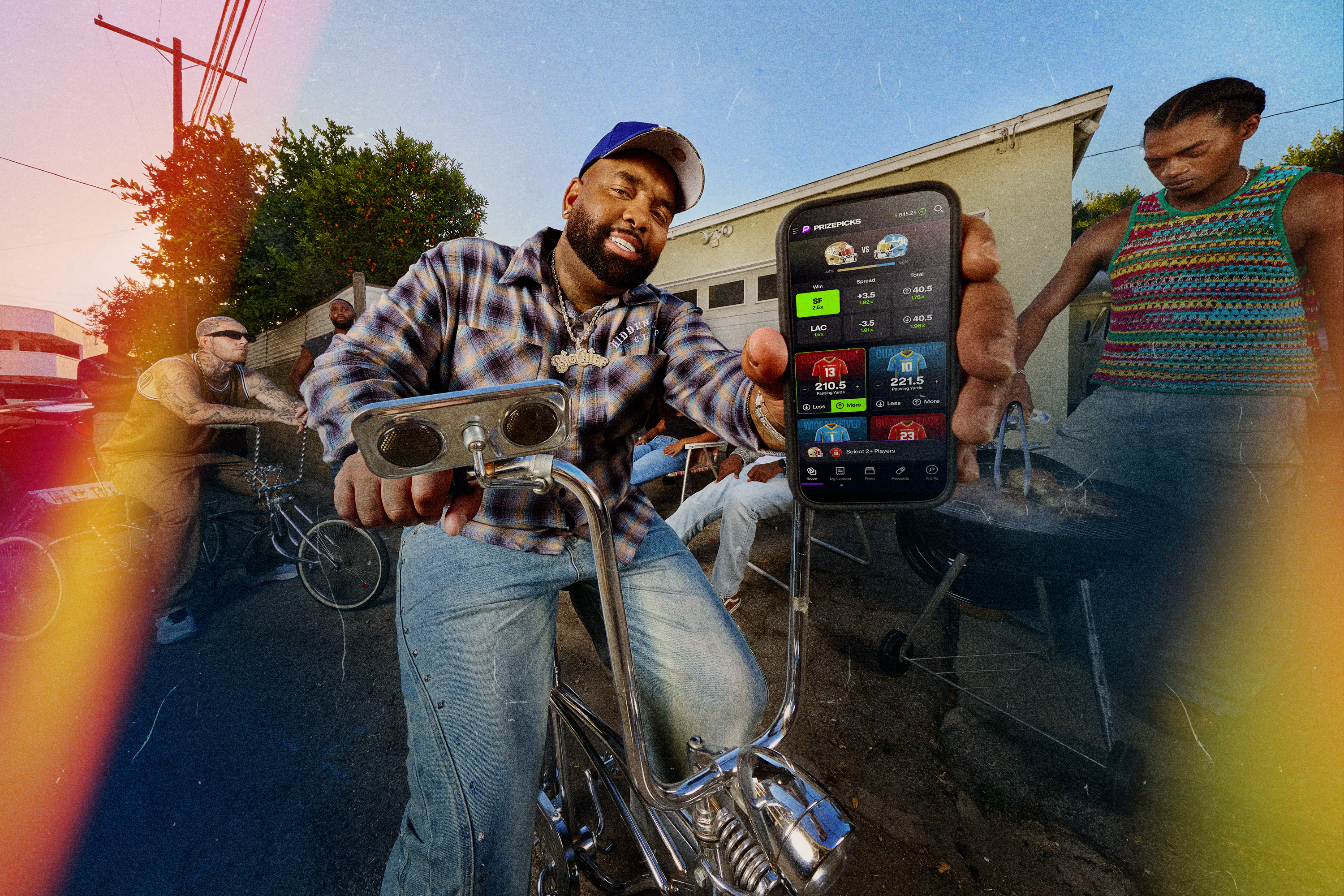
One more strategy ran this season, competing on who the product belongs to. That's PrizePicks and Druski, and since we made that work, we'll let someone else grade it.
What opportunities are sports betting brands missing?
The biggest openings are about audience. Every brand sold the same product to the same in-market fan, so four positions sat empty all season: the casual and female fan, a reason to play, emotional storytelling, and trust.
- Everybody chased the same person. The casual fan and the female fan went unaddressed.
- Nobody answered why. The field sold access, offers and presence. Motivation is open territory.
- Nobody used emotion. Twelve campaigns, all comedy or spectacle.
- Nobody owns trust. In a category under legal siege, the responsible, transparent position is empty.
Most brands get seen. Few get remembered. Availability expires and offers are rented. Novelty fades faster than either. The question we ask on every job is what someone will remember tomorrow, and this season most of the category answered with a price.
We think belonging is the one asset in this category that compounds, and right now almost nobody is building it.
FAQ
Category national TV spend reached an estimated $269.8 million through late August 2026, up 40% year over year, according to iSpot. In the thirty days around NFL kickoff, DraftKings led with 10,783 national airings, followed closely by Kalshi at 10,327.
About Colormatics
Colormatics is a creative studio for sports and culture, with offices in Spokane and Austin. We pair art with purpose. The Color side brings the joy, the levity and the visuals people screenshot. The Matics side respects the budget and cuts the fluff. The goal on every job is work that's memorable on screen and off, for brands like PrizePicks, MLB, Fiverr and Sleeper. Want to be the brand people still talk about next season? Grab a time with us.
Sources
- NFL-season wagering forecast and prediction-market share (Eilers & Krejcik via SiGMA)
- Week 1 app downloads, Sensor Tower data (iGaming Business)
- Week 2 downloads, Sensor Tower via Citizens (Legal Sports Report)
- National TV ad spend, iSpot estimates (MediaPost)
- DraftKings' nationwide campaign with Kevin Hart and Nick Jonas (Bonus.com)
- Kalshi's Beast Mode launch (Adweek)
- NFL ban on prediction-market advertising (Casino.org)
- Ninth Circuit ruling against Kalshi (Covers)
- New Jersey's Supreme Court petition (Gambling.com)
- 39 states and D.C. back the petition (Gaming.net)